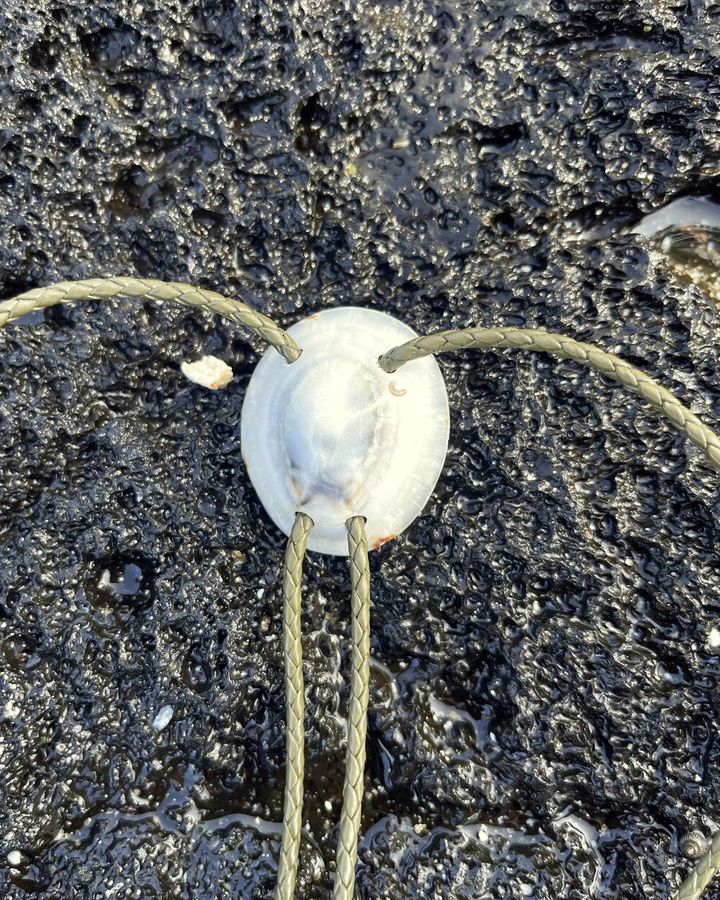
Heirloom jewelry has almost nothing to do with the price tag. We call a piece an heirloom not because of what it cost, but because of what it carries — a person, a place, a story worth keeping. It's the ring a grandmother wore, the watch a father set on the dresser every night. The value is the memory. Most jewelry sold today is made to be replaced next season; an heirloom is made to be kept, worn soft with use, and passed to the next pair of hands.
What actually makes a piece an heirloom
It isn't karats or a designer's name. Three things turn an object into an heirloom: it has to be singular — genuinely one, not one of thousands; it has to hold a story that travels with it; and it has to be made well enough to survive being loved for decades. Miss any one of those and you have a nice accessory. Hit all three and you have something a family keeps.
One of a kind, so it can never be replaced
Every Holo Holo Bolo begins as a single shell I found on a Big Island shore. That shell existed exactly once. When it's shaped, polished, and set on its cord, the result cannot be reordered, reissued, or matched — not by me, not by anyone. There is no "model number." That unrepeatability is the quiet backbone of any heirloom: the reason a piece can't simply be swapped for a newer one is that a newer one does not, and cannot, exist.
Made to be worn, not stored away
An heirloom that lives in a drawer isn't doing its job. These pieces are built from materials that age with grace rather than falling apart. The shell is real and hard-wearing, polished through the grits until its color comes up from within. The cord is high-end organic leather, which does what good leather does — it darkens, softens, and takes on the character of the person wearing it. Given the small care any fine natural piece deserves, a bolo worn today can be worn just as proudly in forty years, carrying the marks of every year in between.
"An heirloom isn't the most expensive thing you own. It's the one you'd run back into the house for."
The story travels with the piece
A gem cut from a mine has no address. Every one of mine does. It came from a specific beach, on a specific island, gathered by hand — and it leaves with a provenance card that says so. That's the beginning of the story, not the end of it. The rest gets written by whoever wears it: the wedding it showed up to, the trip it came home from, the grandchild who finally asked, "where did this come from?" An heirloom is really just a well-made object with enough room in it for a life to be recorded.
A modern heirloom for the person who has everything
The hardest people to buy for are the ones who already own whatever they want. What they usually don't have is something the world made exactly one of — a piece with a place of origin, a maker's hands, and a story only they will carry forward. That's what makes a one-of-a-kind shell bolo such a fitting gift for a milestone, a wedding, or an anniversary: it isn't bought to be used up. It's given to be kept, and one day, given again.
That's the whole idea behind this work. Not fashion, which is designed to expire — but an artifact you wear, made to outlast the season, the trend, and eventually, quietly, us.
— Aaron
Every piece in the collection exists exactly once — gathered, polished and built by hand in Kailua-Kona, and made to be worn for decades before it is handed on.