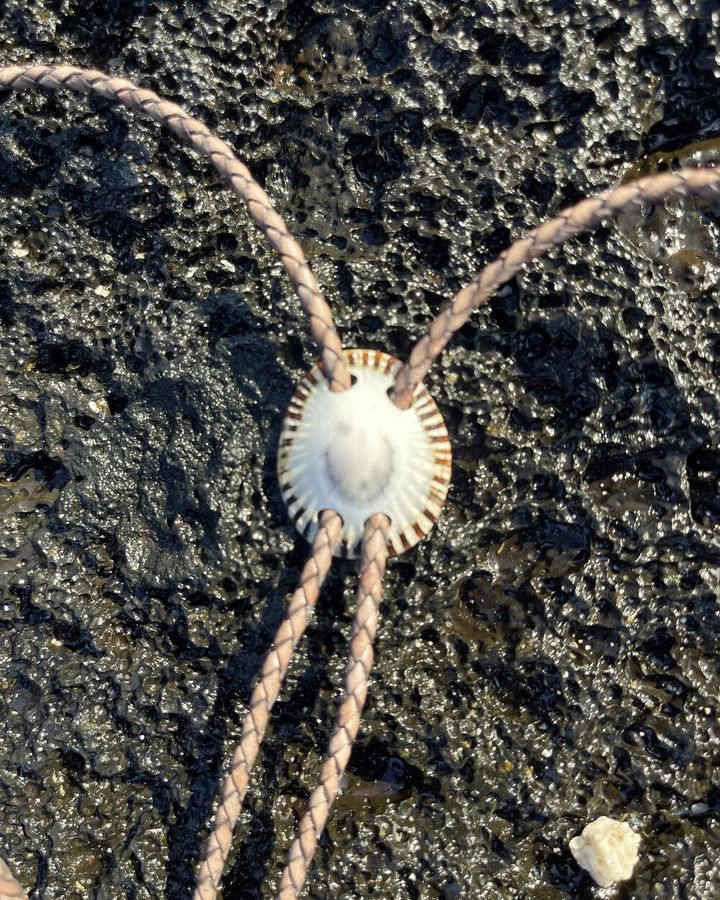
A traditional bolo tie is held together by metal. There is a spring-loaded slide clamped onto the cord, a pair of stamped metal tips capping each end, and often a dab of glue hidden where the shell meets its mount. It works, but it is a lot of hardware to hang on something as quiet as a shell. Over the last year, more and more of my pieces have shed all of it. What I build now is a metal-free bolo tie — no clasp, no glue, no stamped tips — just a hand-finished Hawaiian shell on a supple organic leather cord. Taking the metal out changed how the pieces feel, how they wear, and, honestly, how proud I am to send them out the door.
What "metal-free" actually means here
The clasp-less design has been my signature from the start, and it's still how I finish most pieces. Instead of clamping a metal slide onto the cord, I set the shell so the leather passes through the piece itself and holds by friction and fit — the way a well-tied knot holds. That removes the single most uncomfortable part of a conventional bolo. On a growing number of pieces I now go the whole way and replace the two metal end-tips as well, finishing each cord with a matching pair of small shell tips instead. When a piece is fully metal-free, there is no nickel, no plated brass, and no adhesive anywhere in it — only shell, leather, and the join between them. It is a Hawaiian shell bolo tie stripped back to its two honest materials.
Why less metal means more comfort
The difference shows up the moment you put one on. A metal slide is cold against the collarbone, it adds weight that pulls the piece off-center, and its clamp is the part most likely to loosen or bite over a long day. Take it away and the bolo settles lighter and flatter, moving with you instead of swinging. For anyone who has ever found a metal clasp cold, heavy, or irritating against the skin, there is simply nothing there to bother them. The organic leather cord does the rest: it is soft from the first wearing rather than stiff, it warms to your skin, and it ages into a patina that cheap coated cord never develops. Comfort is not a small thing in a piece you want someone to actually reach for — the most beautiful bolo in the world does no good sitting in a drawer because it is a chore to wear.
A note on the leather: because the cord is real, un-coated leather, it wants to stay dry. Keep it out of the shower and the ocean, let it breathe rather than sealing it in a plastic bag, and it will outlast almost anything with a clasp. Full care notes live in the journal's guide to caring for a shell bolo.
Honest materials, nothing hidden
There is a Hawaiian word I keep in mind while I work — pono, which means to do a thing properly, in right and true order. Building metal-free is my small way of keeping a piece pono. A hidden dab of glue or a stamped tip is where a lot of jewelry quietly cuts a corner; it is the part the buyer never sees and never questions. When the whole piece is only shell and leather, there is nowhere to hide a shortcut. What you are holding is exactly what it appears to be: a shell that spent its life on the shore of the Big Island of Hawaiʻi, gathered by hand and finished on the wheel until its own colors came up, joined to a cord good enough to carry it for decades. Nothing added to fake permanence, and nothing hidden to fake value.
"When a piece is only shell and leather, there is nowhere to hide a shortcut."
Who a metal-free piece is for
It suits the person who notices how things are made — who turns a piece over to see how it is joined, and appreciates when the answer is simple and sound. It suits anyone who finds metal jewelry cold, heavy, or irritating and has quietly given up on wearing a bolo because of it. And it suits collectors of wearable art, because a fully metal-free, all-shell bolo is genuinely uncommon; most of what is sold as a shell bolo is really a shell glued to a metal fitting. Not every piece in the collection is all-shell yet — some designs still call for a tip that only metal can give — but the direction is clear, and I will always tell you exactly which a given piece is. If you would like a fully metal-free bolo built around a particular shell, that is one of the loveliest commissions to take on.
— Aaron