For a Hawaii beach wedding, wear light natural fabrics in light colors: linen or cotton trousers, an open-collar linen shirt or a well-tailored aloha shirt, and either sandals or bare feet. Leave the wool suit, the heavy jacket and the necktie at home — the heat and the trade winds beat all three by the second photo. The dress code most couples mean when they write "beach formal" is elevated island casual, and it is a real dress code with real rules.
I live in Kailua-Kona and I make shell bolo ties here, so I get asked this question a lot, usually by somebody on the mainland holding a garment bag and a plane ticket. Here is the honest version.
The dress code, translated
Couples write all kinds of things on an invitation. In Hawaiʻi they mostly mean the same thing: look put together, but dress like a person who has been outside before.
- Beach formal / island formal — long trousers, collared shirt, no jacket required. This is the most common.
- Beach casual / aloha attire — a good aloha shirt, chinos or linen pants, sandals.
- Black tie on a beach — rare, and if you see it, the ceremony is probably on a lawn or a lanai, not on sand. Ask.
If the invitation says nothing at all, aim at beach formal. Slightly overdressed reads as respect. Slightly underdressed reads as "I did not read the invitation."
What the groom wears
The formula that works, in order of how often I see it hold up in the heat:
- Linen or linen-blend trousers in white, cream, sand, light grey or soft sage.
- An open-collar linen or cotton shirt, or a genuinely well-made aloha shirt with a restrained botanical print. A cheap aloha shirt reads as a costume. A good one reads as formalwear here, and always has.
- A vest or suspenders if you want structure without a jacket. Best trade in beach menswear — the shape of a suit, none of the sweat.
- Something at the throat that is not a necktie. More on this below.
- A lei, usually maile for the groom, draped rather than closed. The couple or officiant normally arranges this, so ask before buying your own.
Footwear: leather sandals, woven loafers, or barefoot if the ceremony is on sand. Check the beach first — terrain here varies enormously from one to the next.
What guests wear, and what to leave in the suitcase
Guests get more latitude and use less of it than they should. Sundresses, jumpsuits, midi dresses in prints or solids, linen sets, and for men the same trousers-and-collared-shirt formula. Bring a light layer for after sunset.
What consistently goes wrong:
- Stiletto heels on sand. They sink. Wedges, flats or block heels, or plan to go barefoot.
- All-white, unless the couple asked for it. Still the rule, still ignored.
- Anything wool or lined. You will regret it during the ceremony and hate it during the photos.
- A full dark suit. You can wear one. You will be the only person in it, and you will be the only person sweating in it.
Fabric and color do most of the work
Get these two right and you will look correct in every photograph. Fabric: linen, cotton, seersucker, light silk — anything that breathes and moves. Heavy fabrics photograph as heavy. Color: cream, sand, white, pale blue, soft sage, dusty rose. The background is turquoise water and black lava rock, so light colors sit in front of it beautifully and black absorbs straight into the rock.
"Heavy fabrics photograph as heavy."
The accessory that survives the heat
This is where I am biased, so take it accordingly: the necktie is the wrong tool for a beach wedding. It is insulation strapped to your throat, it wilts, and it is the first thing that comes off in the reception photos. The longer argument is in bolo tie vs. necktie.
A bolo does the same job — it finishes an open collar and gives the eye somewhere to land — while leaving your neck open. It reads as dressed without reading as buttoned-up, which is the register a beach ceremony wants. And unlike a rented tie, you keep it.
Every piece I make is one of a kind, because no two shells are alike. The shells I use are gathered empty and dry — most off the Big Island shoreline, a few carried home from travels further afield — and I cut, polish and lace every one by hand here in Kona. A handful of pieces in the collection are curated stone rather than shell, hand-finished in Kona the same way, and each listing says plainly which it is.
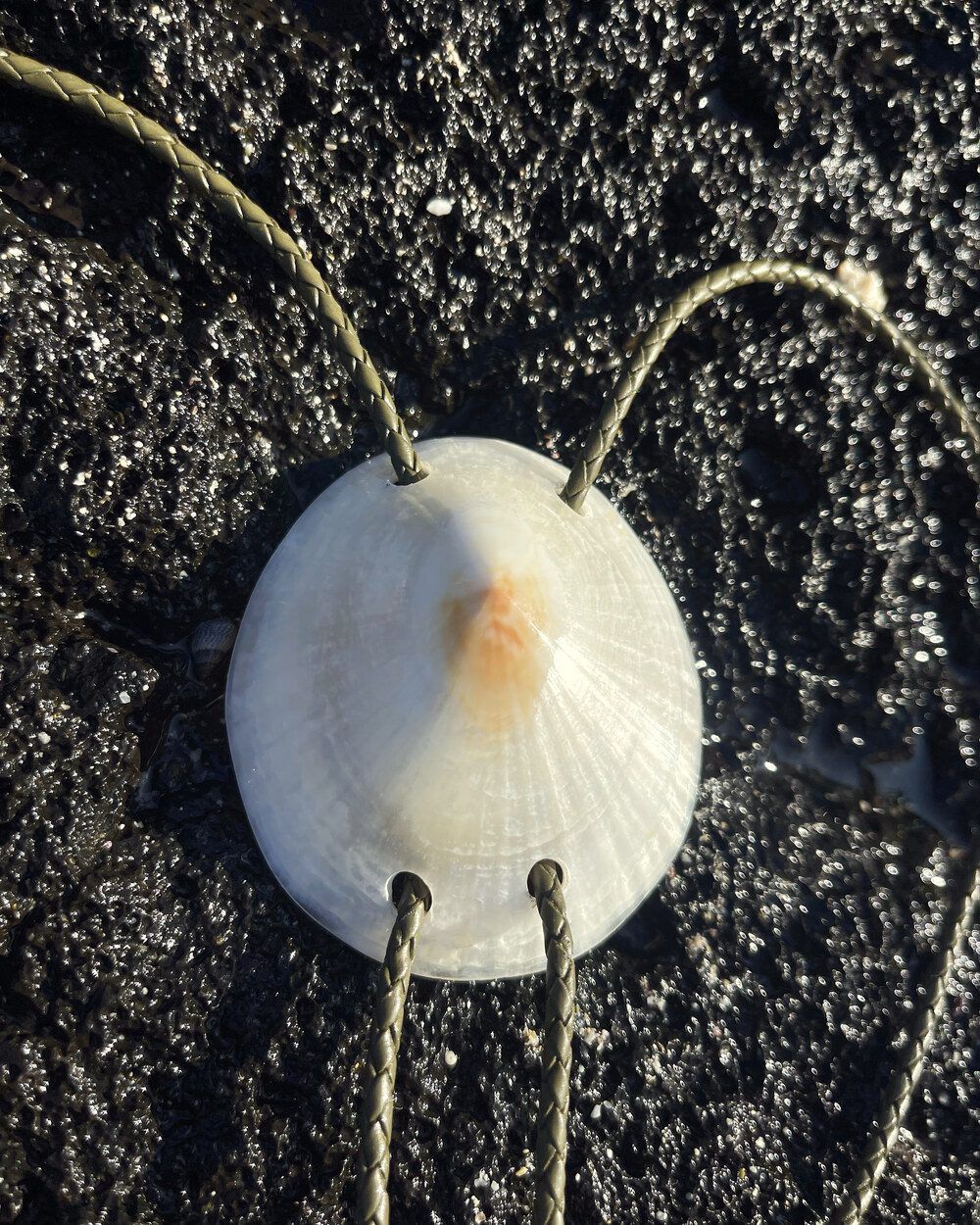
For weddings the pale shells tend to win: Snow Tide, a milky, near-translucent ʻopihi with a single warm spot at its crown, clasp-less on metallic gold; Pale Tide, a milky ʻopihi with the faintest olive flecks and a matched pair of cowrie tips; and Soft Gold, a pale golden-cream shell polished to silk on dark leather with silver tips. All three sit quietly against linen instead of fighting it.
If you are dressing a whole party, start with bolo ties for a beach or destination wedding, and if you are thinking about them as gifts for the groomsmen rather than as uniform, the groomsmen guide is the better place to start. Give yourself real lead time — every piece is the only one of itself, so there is no reordering the same tie twice.
Aaron gathers shells, empty and dry, along the Big Island shoreline and makes one-of-a-kind bolo ties by hand in Kailua-Kona, Hawaiʻi. See what is available now.
Quick answers
Can you wear a suit to a Hawaii beach wedding?
You can, but almost nobody does and you will be uncomfortable. If you want the formality, wear the trousers and a vest and skip the jacket — you get the silhouette and keep your afternoon.
Do you wear shoes at a beach wedding in Hawaii?
Often not. Many ceremonies on sand are barefoot, including the couple. Wear sandals you can slip off, and ask the coordinator, because it depends entirely on the beach.
Is an aloha shirt formal enough for a wedding?
A good one absolutely is — aloha attire is genuine formal dress in Hawaiʻi and always has been. The test is the shirt: real fabric, tailored cut, a print that whispers. A souvenir-shop shirt is not the same garment.
— Aaron