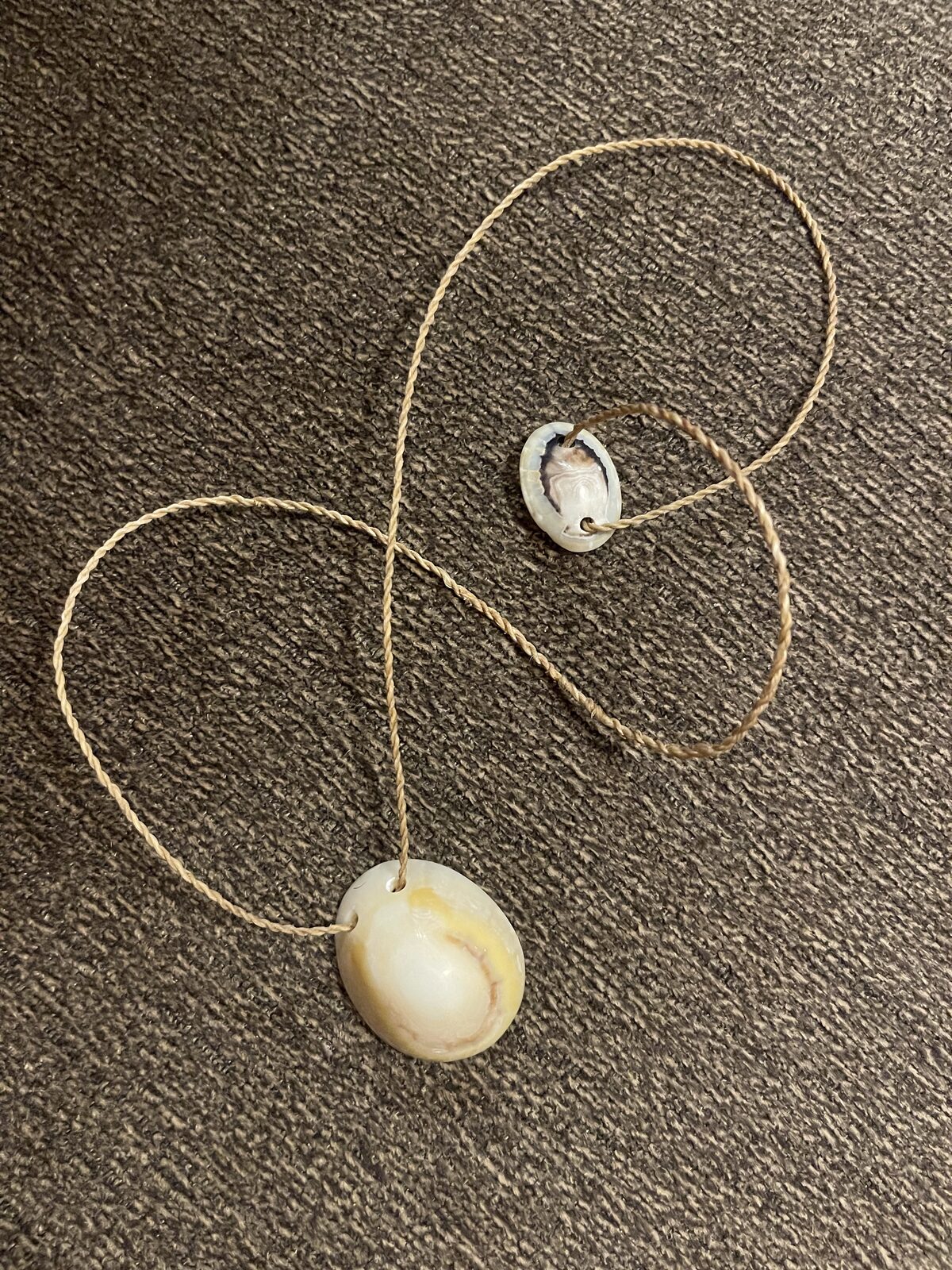
A little while ago I took a cordage class up at the Volcano Art Center, in Hawaiʻi Volcanoes National Park. It was one of those special, hands-on days that stays with you. I came home with a length of cord I'd twisted myself from the hau tree, a polished ʻopihi to finish it into a necklace — and four large blisters on my fingers. I earned every one of them, and I'd do it again tomorrow.
Rope that held a world together
It's easy to forget, but the old Hawaiian canoes had no nails, no screws, no metal of any kind. Every plank, every spar, every part was lashed into place with cordage — which means making strong rope wasn't a craft on the side. It was the thing that held the whole vessel, and the long voyages it carried, together. The great double-hulled voyaging canoes that crossed thousands of miles of open ocean were bound entirely by hand-made line.
I learned something in that class that has stuck with me: a fully rigged voyaging canoe could call for miles upon miles of cordage — as much as twelve, I was told. Twelve miles, made by hand, fiber by fiber. It changes how you look at a single arm's length of rope.
The plants behind the rope
Olonā. The most prized of all was olonā, a plant in the nettle family that grows only in Hawaiʻi. Its fiber is famous as one of the strongest natural cordage materials on earth — remarkably light and remarkably tough. The work was painstaking; even an expert could scrape only a few hundred strips in a day. Passing sailing ships would trade for miles of olonā rigging, considered better in every way than their own rope, at half the thickness.
Hau. The plant I got to work with is hau — the hibiscus. Its bark gives long, strong strips that, braided or twisted, become beautiful cordage. Hawaiians used hau for nearly everything: canoe lashing, slings, bowstrings, net bags, and — close to my heart — lei and necklaces.
ʻAha. And there was ʻaha, sennit twisted from coconut husk fiber. Naturally water-resistant, it was ideal for lashing canoes that spent their whole lives in the sea.
A quiet truth: these skills were nearly lost. By the time the Hōkūleʻa helped revive Hawaiian voyaging in the 1970s, so much of the old cordage knowledge had faded that modern line was used for safety. That's part of why working even a small length of hau by hand feels like helping keep something alive.
My own four blisters
I won't pretend I was any good at it. Hau fiber doesn't give itself up easily, and by the end my fingers were raw and blistered. But a particular kind of respect arrives when you feel, in your own hands, how much effort lives inside a single length of cord — and then try to imagine twelve miles of it. I came home, finished my hau cord into a necklace with a polished ʻopihi at its center, and just sat with it for a while. Very special.
"It starts with a shell, a little patience, and the willingness to do the work."
Where I'm taking it
This is a new craft for me, and I mean to keep at it — to put in the hours, build the calluses, and get good. My hope is to one day bring hand-made natural cordage and natural shell pieces into my bolos, so that a piece can be fully natural and fully handmade, from the shell at its heart to the cord around your neck.
I'm not there yet. But like everything I make, it begins with a shell, a little patience, and the willingness to do the work — blisters and all.
— Aaron