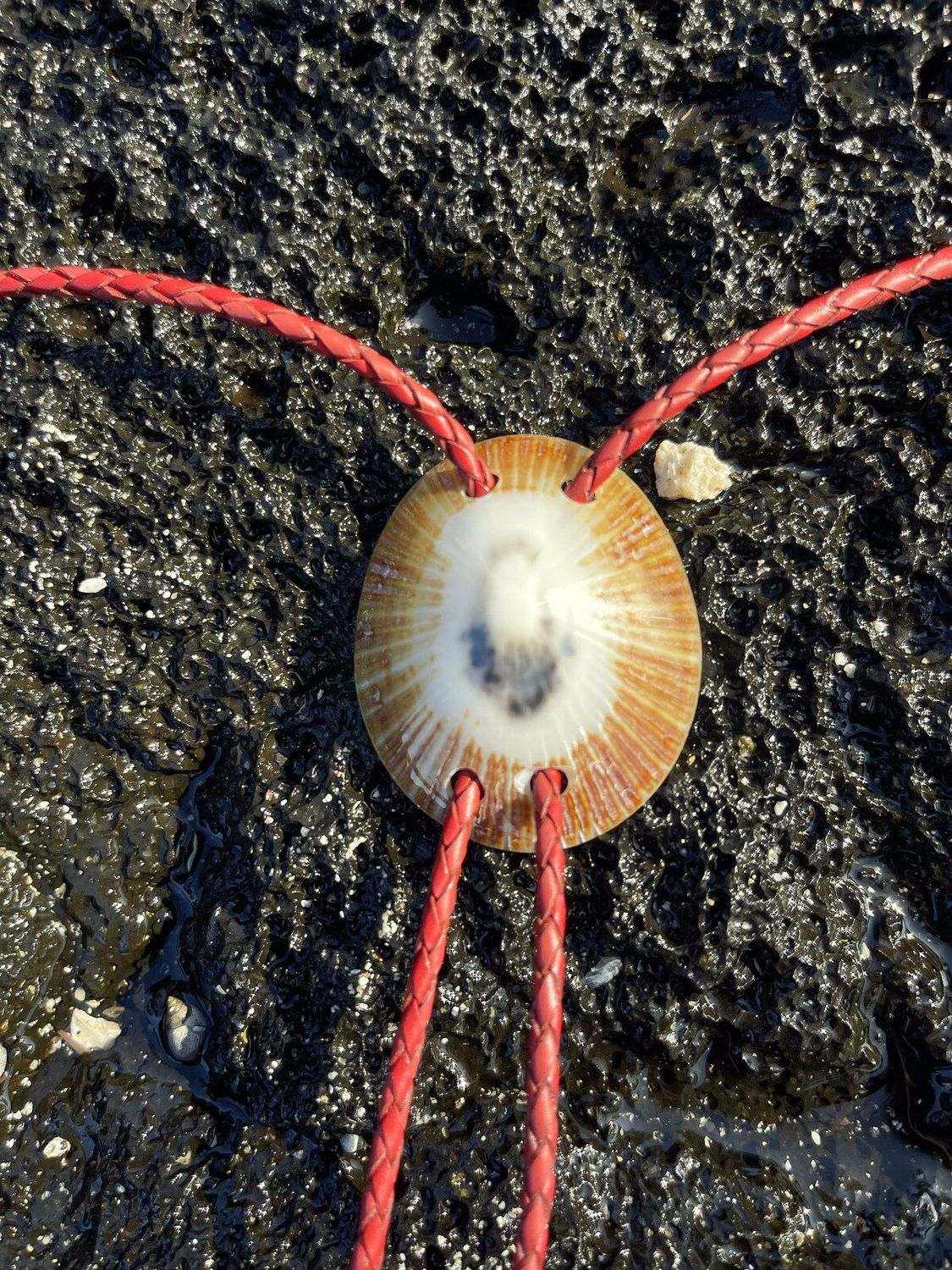
Choosing your first bolo tie should feel less like shopping and more like meeting something. People often come to me a little unsure — is it too western, too dressy, will it suit me — and then they hold one, and the questions fall away. This guide is here to make that moment easier: a plain-language walk through what a bolo tie actually is, the few parts worth understanding, and how to pick a first one you'll genuinely reach for.
First, what a bolo tie is made of
A bolo tie is beautifully simple. There are only three parts. The slide (sometimes called the clasp) is the decorative centerpiece — for my work, that's a hand-polished Hawaiian shell — and it slides up and down to sit wherever you like at the collar. The cord is the loop that goes around your neck, usually braided leather, though woven and waxed cords are common too. And the tips — technically called aglets — are the finished ends that weight the cord and keep it hanging cleanly. Once you can name those three, you can judge any bolo tie in the world.
Start with the centerpiece — it's the whole point
Everything else is hardware; the slide is the soul. This is the part people notice, the part you'll fall for, and the part worth choosing with your gut rather than a checklist. Look at it the way you'd look at a small piece of art: does it hold your eye, does it feel alive, would you still love it in ten years? With a natural material like shell, no two are ever the same — the ridges, the luster, the exact turn of color belong to that one shell and no other. Pick the one that quietly won't let you go.
A small test: if you find yourself coming back to look at the same piece two or three times, that's your answer. The right bolo tie tends to choose you as much as you choose it.
Cord: color, material, and feel
Cord is where you set the mood. Darker leather — deep brown or black — reads dressier and disappears against a jacket, letting the centerpiece do all the talking. Lighter or braided cords feel more relaxed and handmade. For a first bolo, a mid-to-dark braided leather is the safest, most versatile choice; it works with a linen shirt on a warm evening and with a blazer just the same. Give the cord a gentle tug when you can — good leather feels supple, not stiff or plasticky, and it only softens with wear.
Length and fit
Most bolo ties run roughly 36 to 42 inches of cord, and the slide lets you wear it high like a collar piece or loose like a long pendant, so fit is forgiving. As a starting point: for an open collar, let the slide rest a few inches below your collarbone; with a buttoned shirt, snug it up near the top button. Taller folks and layered looks suit a longer drop; a higher, tighter slide looks sharp under a jacket. There's no single rule — the beauty of a bolo is that you adjust it to the shirt and the day.
"Buy the one you'll actually wear — not the one you think you're supposed to."
Match it to what you already own
You don't need a new wardrobe. A bolo tie loves a plain shirt — chambray, white linen, a solid oxford — because a quiet background lets the centerpiece shine. If most of your shirts are casual, choose a slide and cord that feel earthy and relaxed. If you're buying it for weddings, dinners, and events, lean toward a darker cord and a refined stone. One good bolo can cross from a beach ceremony to a nice restaurant without missing a beat, which is part of why people who buy one so often come back for a second.
Occasion and the "why"
It helps to know what you're reaching for. A first bolo as an everyday signature piece can be bolder and more personal. One bought as a gift — a groomsman, a father, an anniversary — leans a little more classic and safe, since it needs to suit someone else's taste. And one meant for a specific event can echo that setting: an ocean-toned shell for a beach wedding, something warmer and richer for the holidays. If a keepsake matters more than a category — a shell from a place you love — that's exactly the kind of thing I'll build a commission around.
A word on why one-of-a-kind is worth it
You can buy a mass-produced bolo tie for very little, and it will look like exactly what it is. A handmade one costs more because someone gathered the material, read the grain of it, and finished it by hand — and because it is the only one of its kind on earth. For a first piece, I'd rather someone own one honest, unrepeatable bolo they love than three they forget. It's the difference between an accessory and an heirloom.
So — how do you choose?
Understand the three parts, choose a versatile mid-to-dark cord, mind the length, and then let the centerpiece decide. Trust the piece you keep looking back at. Here in Hawaiʻi we have a word, holoholo — to wander without a fixed destination, for the pleasure of it. Choosing your first bolo tie is a little like that. Enjoy the looking. The right one has a way of finding you.
— Aaron