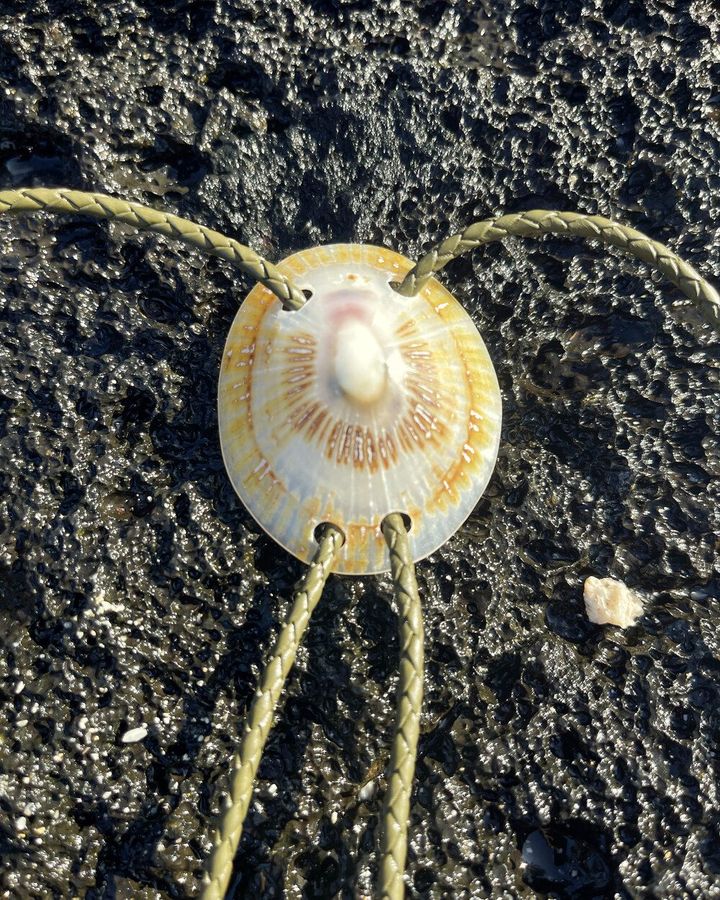
When you polish enough ʻopihi, you stop being in charge. You learn to follow the shell instead — and when one starts to come alive on the wheel, when it's flowing, you keep going. Each one reveals a different face. Over the years I've come to recognize a few of them, the way you'd recognize old friends in a crowd.
The horseshoe look
Some ʻopihi polish up with a clean band arcing across the dome like a horseshoe — a curve of brighter color riding over a darker ground. There's a reason one of my pieces carries that name. It reads as luck and motion, and it's striking at the collar.
The shiny look
Now and then a shell takes the polish so completely that it turns almost glassy — a deep, wet shine that catches the light and holds it. These are the ones that stop people across a room. The glow was always in there; the wheel just coaxes it to the surface.
The eyeball look
Others finish with a bright center ringed by darker bands, so the whole shell seems to look back at you — an eye, an iris, something almost alive. It's a little uncanny and a lot beautiful. People feel it before they can explain it.
The pure-nature look
And some I leave close to how the sea made them — soft, matte, honest, the texture and tide-marks intact. Not every shell wants a high shine, and not every shell should have one. The art is knowing which is which.
"Each one decides what it wants to become. My job is to listen."
Mounds by the old fire pits
Out on my hikes along the shoreline, I've come across something that stops me every time: great mounds of ʻopihi shells gathered beside old fire pits, where people cooked and ate them over flame long ago. Standing there, you can feel the gatherings that happened on that spot. I find myself wondering how old some of them are — decades, centuries?
These are not finds to take from. They're middens — the remains of meals and lives, and in Hawaiʻi they're treated as archaeological and cultural sites, protected by law. I never take a single shell from them. I just stand quietly, with respect, and let them be exactly as I found them. To admire is the whole point; to disturb would be to lose what makes them sacred.
If you ever come across one: leave it untouched, take only a photo, and let it rest. These places belong to the island's story, not to a pocket.
Why it matters at your collar
This is the quiet truth behind every Holo Holo Bolo: because each shell arrives with its own character and finishes its own way, no two pieces can ever be the same. Nothing is forever, and everything is temporary — which is exactly why a one-of-a-kind piece, caught at its peak and never repeated, is worth wearing close.
— Aaron