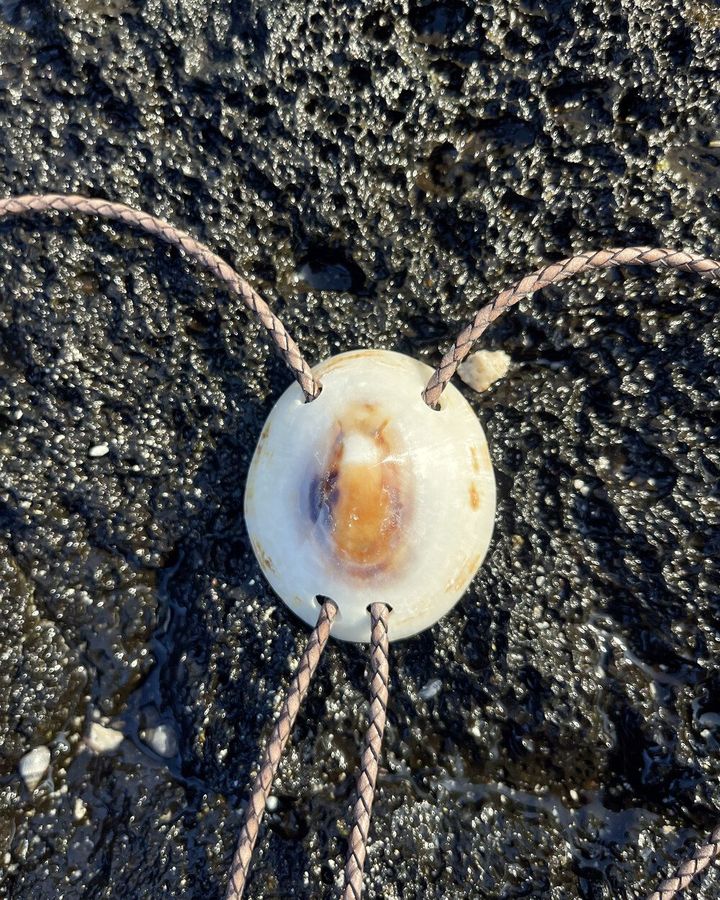
ʻOpihi is the Hawaiian limpet — a small, cone-shaped shellfish that clamps onto wave-washed lava rock along the shoreline. Hawaiʻi has several kinds found nowhere else. It is a treasured food, it appears in the Kumulipo origin chant, and it is so dangerous to gather that Hawaiians call it "the fish of death."
Most of my pieces begin as an ʻopihi. Before it is ever a polished shell at someone's collar, it is one of the most treasured things in all of Hawaiʻi — a small limpet with a story that reaches back to the very beginning of the islands. Polished, the ribbed dome shows a different face every time: the warm bands of the ‘Tiger Eye Look’ ʻopihi on a brown-grey cord, the full-moon glow of ‘Mother Moon’, the grey horseshoe swirl of Lucky Eye laced clasp-less on metallic gold, or the single amber-gold blotch at the heart of Golden Core. I wrote about those faces in the many looks of a polished ʻopihi.
What is an ʻopihi?
An ʻopihi is a limpet — a small shellfish that clamps onto wave-washed rock with a grip so strong it seems part of the stone itself. Hawaiʻi has several kinds found nowhere else on earth: the ʻopihi makaiauli (blackfoot), which rides high above the tide; the ʻopihi ʻālinalina (yellowfoot) of the intertidal zone; and the ʻopihi koʻele (kneecap), which lives fully underwater. Each wears a low, ribbed, oval dome of a shell — the very shape you'll recognize at the heart of my work.

A treasured tradition
For Hawaiians, the ʻopihi has always been far more than a shell. It appears in the Kumulipo, the great Hawaiian origin chant, woven into the story of the islands from the very start. Over the centuries it has served as food, as tools, and as adornment — and to this day it is a cherished delicacy, gathered, salted, and shared at lūʻau and special gatherings. A small bowl of ʻopihi is a sign of real hospitality and respect.
"The fish of death"
There's a reason ʻopihi is so prized: it is dangerous to gather. Hawaiians call it he iʻa make ka ʻopihi — "the fish of death." Pickers climb out onto rocks in the surf zone, pry the shells loose between sets, and scramble back before the next wave hits. People have lost their lives to a rogue swell while gathering them. It is, quite literally, hard-won.
Gathered with respect
Traditionally, ʻopihi harvest was watched over by konohiki — local resource managers — who set strict limits on the size, number, season, and place of gathering so the populations could replenish. That wisdom matters more than ever, as ʻopihi have been over-harvested in many places. I try to hold that same respect in how I work: the shells I gather get a second life — nothing treasured is wasted — hand-polished into something that can be kept and worn rather than left to the tide.
I want to be honest about how much this matters to me. I hold deep respect for Hawaiian culture — it has changed me and the way I live for the better, and I never take that lightly. Not long ago I shared my story and my intentions with a Hawaiian cordage practitioner. After hearing me out, he told me I'm not doing anything wrong — that giving these shells a second life, made with care and gratitude, honors the tradition rather than takes from it. That conversation meant a great deal to me, and I carry it with me in every piece I make.
Limpets around the world
Hawaiʻi is far from alone in its love of the limpet. On rocky coastlines across the globe, people have gathered and eaten limpets since ancient times — the Greeks, the Romans, and the Vikings all did. In the Azores and Madeira, lapas grelhadas — limpets grilled in their own shells with garlic, butter, and paprika — are a beloved delicacy. They've been eaten in Spain (as llámpares in Asturias), in Portugal and Ireland, and along the shores of Chile and Mexico. Wherever the waves meet the rocks, it seems, people have found the limpet.
A humble secret: the teeth of the common limpet are the strongest known biological material on earth — stronger, pound for pound, than spider silk. There's that theme again: the most ordinary-looking things often hold the most extraordinary things inside.
"You're wearing a small piece of a very long story."
From the shore to something you wear
Food, tool, adornment — the ʻopihi has been all three to the people of these islands for centuries. With my pieces, I carry that last tradition forward with gratitude and respect: giving a gathered shell a second life, hand-polished into something one of a kind. When you wear one, you're connected to a long story — shared by island people and shoreline gatherers all around the world.
Quick answers
What does ʻopihi mean in English?
ʻOpihi is the Hawaiian word for limpet — a small, cone-shaped shellfish with a low, ribbed, oval shell that clamps onto rock in the surf zone. The word is spelled with an ʻokina (the glottal-stop mark) before the o.
Why is ʻopihi called the fish of death?
Because gathering it is dangerous. Pickers climb onto rocks in the surf zone, pry the shells loose between wave sets and scramble back before the next one hits; people have been lost to rogue swells. The Hawaiian saying is he iʻa make ka ʻopihi.
What kinds of ʻopihi are there in Hawaiʻi?
Four are shown in the chart above; the three most often named are ʻopihi makaiauli (blackfoot), which rides high above the tide; ʻopihi ʻālinalina (yellowfoot) of the intertidal zone; and ʻopihi koʻele (kneecap), which lives fully underwater. The chart above shows them side by side.
Can you eat ʻopihi?
Yes — it is a cherished Hawaiian delicacy, gathered, salted and shared at lūʻau and family gatherings. A bowl of ʻopihi is a sign of real hospitality. Traditional harvest was managed by konohiki with limits on size, number, season and place so populations could recover.
Is the ʻopihi shell used in jewelry?
Yes. Once the animal has been eaten or the empty shell has washed ashore, the shell can be cleaned, tumbled and polished on a lapidary wheel until its colour comes through — see how a rough shell becomes a polished gem. Most Holo Holo Bolo pieces are built around a single hand-polished ʻopihi.
— Aaron