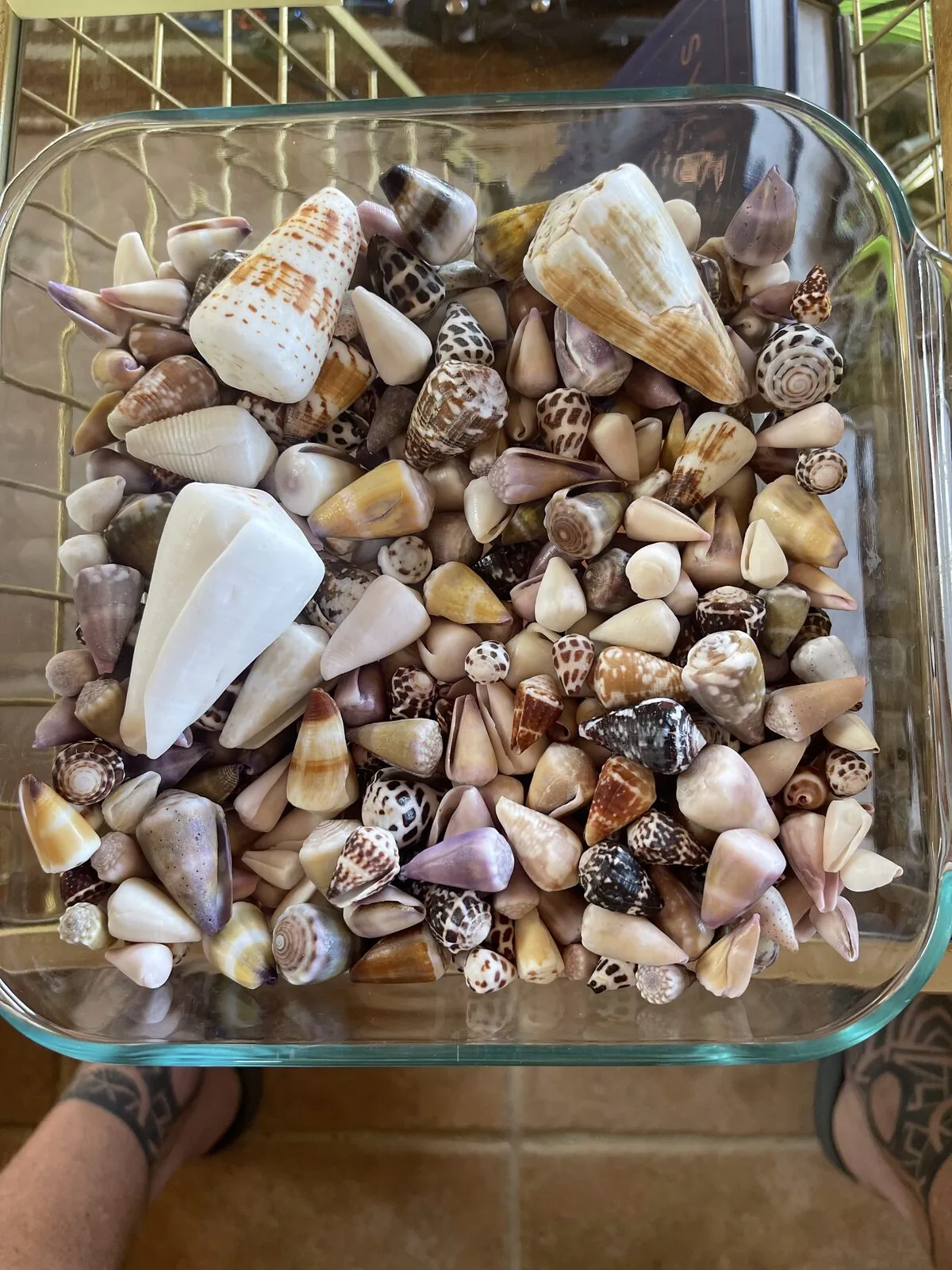
The five Hawaiian shells most people ask about are the ʻopihi (limpet), the cowrie (leho), the cone, the sunrise shell and the puka. Below is how to recognise each one on the shore, what its name means, which to leave alone, and which become wearable art.
Two of them are the backbone of my work. The cowrie becomes pieces like Kona Dusk, a smoky taupe cowrie showing its fine-toothed smile on dark pink cord with brass tips, and Wild Lavender, a leopard-spotted cowrie in lavender and tan finished with spiral cone tips. The ʻopihi becomes pieces like Ocean Eye, whose pale centre rings like an eye, laced clasp-less on metallic gold cord with cowrie tips. Where I find them is in Beachcombing the Big Island.
Walk a Hawaiian shore with your eyes down and the islands start handing you small treasures. Over the years I've come to know these shells the way you know old friends. Here's a short field guide to the most beloved Hawaiian shells — including the ones that find their way into my work.
ʻOpihi (the Hawaiian limpet)
An ʻopihi is a limpet — an oval shell shaped a little like a flattened volcano, with a low ridged dome rising to a center. It clings to wave-washed rock, and it's a treasured Hawaiian food with deep cultural roots. It's also the shell at the heart of most of my pieces. Read its full story here.
Cowrie (leho)
Known in Hawaiian as leho, the cowrie is easy to spot: a glossy, folded oval with a ridged seam running along its underside. They come in a wonderful range of colors and sizes, and their smooth shine has made them prized for adornment across the Pacific for centuries.
Cone shells
Cone shells are tapered and beautifully patterned — little works of art in their own right. One important note: living cone snails can deliver a venomous sting, so they should never be handled alive. Admire empty shells only, and leave anything living right where it is.
Sunrise shell
Perhaps the most treasured shell in all of Hawaiʻi, the sunrise shell is a deep-water scallop glowing with the yellows, oranges, and pinks of a Hawaiian dawn. They're scarce and hard to come by, which is exactly why finding one feels like winning a small lottery from the sea.
Puka shell
Puka means "hole" in Hawaiian. These little beads form naturally — often from cone shells worn down over years of tumbling in the surf — leaving a softly domed shape with a natural opening in the middle. Strung together, they make the classic Hawaiian necklace generations have loved.
A respectful word on Niʻihau shells
You may also hear of Niʻihau shells — tiny, exquisite shells from the island of Niʻihau, made into world-renowned lei. The craft is a treasured Native Hawaiian art, and "Niʻihau shell" is a legally protected designation reserved only for shells from that island. It's a tradition to admire and respect, not imitate.
"Every shell is a small piece of the islands you can carry."
Which become wearable art
I work mostly with ʻopihi and other shells the tide has worn and left behind, finishing each by hand into a one-of-a-kind bolo. Whatever the shell, the rule is the same: gather only empty shells, in small amounts, never living animals, and never from protected areas. The shore gives generously when you treat it with respect.
Quick answers
What is the Hawaiian name for a cowrie shell?
Leho. The cowrie is a glossy, folded oval with a toothed seam running along its underside, and its shine has made it prized for adornment across the Pacific for centuries.
What is the difference between a puka shell and a cowrie?
A puka is not a species — puka means hole. Puka shells are the worn-down tops of cone shells (and others) that the surf has tumbled into a small dome with a natural hole in the middle. A cowrie is a whole, glossy shell with a slit underside.
Are cone shells in Hawaiʻi dangerous?
Living cone snails can deliver a venomous sting, so never handle one alive. Empty, weathered cone shells are safe to admire and are the source of most puka beads.
What is the rarest Hawaiian shell?
The sunrise shell — a deep-water scallop glowing with the yellows, oranges and pinks of a Hawaiian dawn — is perhaps the most treasured and hardest to find. Niʻihau shells, tiny shells made into lei on that island, are a legally protected designation and a Native Hawaiian art to respect, not imitate.
Can you take shells from a Hawaiian beach?
My own rule, and the one I recommend: gather only empty shells, in small amounts, never a living animal, and never from protected areas or parks that prohibit it. Check the rules for the specific beach before you pocket anything.
— Aaron