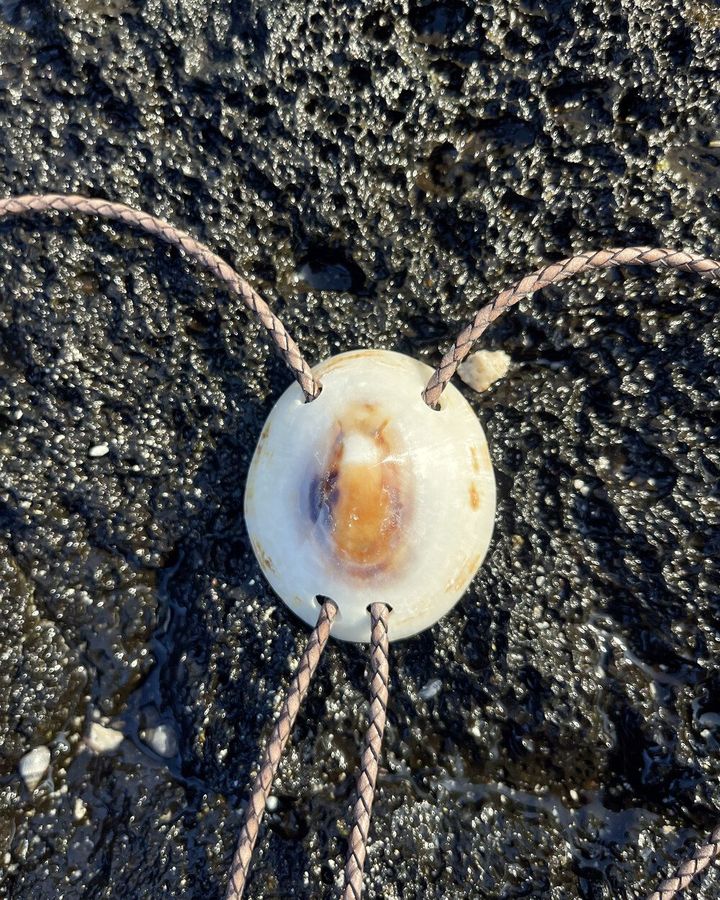
Lapidary is the craft of shaping and polishing hard natural materials — stone, gem and shell — by abrasion: working the surface with progressively finer grits until what was dull becomes luminous. On a shell it takes five steps: clean, tumble, grind, polish through the grits, and wet-drill.
The proof is in the finished pieces. The ‘Tiger Eye Look’ ʻopihi pictured above came up banded in warm tiger-eye tones; Sunburst Ember revealed white rays bursting from an amber heart across a maroon-rimmed ʻopihi; and Secret Lavender is a cowrie sanded open to a polished lavender window beneath its frosted shell. None of that colour was visible on the beach. Once a piece is finished, caring for it is simple.
People often pick up one of my pieces and ask the same thing: how does a plain shell off the beach end up glowing like this? The answer is lapidary — the old craft of grinding and polishing stone, which works just as beautifully on shell. It's equal parts science, patience, and faith that there's something hidden in there worth uncovering.
What "lapidary" means
Lapidary is the art of shaping and polishing hard natural materials — gemstones, rock, and shell — using abrasion. In practice that means wheels and grits: you work the surface with progressively finer abrasives until what was dull becomes luminous. It's the same family of techniques that turns a rough stone into a faceted gem.
How a shell becomes a gem
- Clean & condition. The shell is cleaned and conditioned to lift away the dull, weathered outer layer the sea and sun left behind.
- Tumble. Time in the tumbler softens rough edges and begins to even the surface — nature's surf, sped up and controlled.
- Grind & shape. On the lapidary wheel, the shape is refined and the true surface is brought forward.
- Polish through the grits. Working from coarse to very fine, each pass takes the shine a little deeper, until the color underneath finally comes alive.
- Wet-drill. A careful, water-cooled drill lets the cord pass through without cracking the piece.
"You can't rush a shine. It arrives one grit at a time."
Why it takes so long
There are no shortcuts. Skip a grit and you'll see it; rush the wheel and you can crack a shell you've already spent hours on. Each piece moves at the speed of patience — which is exactly why a finished one feels the way it does.
The reveal
My favorite moment is when the color finally breaks through — an amber heart, a flash of blue, a sunrise blush no one would have guessed was hiding in a chipped little shell. That's the whole reason I do this: proof that beauty is often just below the surface, waiting for someone patient enough to bring it out.
Quick answers
What does lapidary mean?
Lapidary (from the Latin lapis, stone) is the art of cutting, shaping and polishing hard natural materials — gemstones, rock and shell — using abrasion. A person who does it is also called a lapidary.
Can you do lapidary on shells?
Yes. Shell is softer than most gem rock but takes the same approach: tumble to even the surface, refine the shape on the wheel, then polish through progressively finer grits. Working wet keeps the shell cool so it does not crack.
What is the lapidary process, step by step?
Five steps: clean and condition the shell to lift the weathered outer layer; tumble to soften edges; grind and shape on the lapidary wheel; polish from coarse to very fine grit; then wet-drill a hole for the cord with a water-cooled bit.
Why does polishing a shell take so long?
Because every grit has to be finished before the next one starts. Skip a grit and the scratches show in the final shine; rush the wheel and a shell you have spent hours on can crack. The polish arrives one grit at a time.
What is a lapidary polish?
The final, finest stage of the grit sequence, where the surface goes from smooth to mirror-bright and the colour underneath finally comes alive — the amber heart, the flash of blue, the sunrise blush. See the many looks of a polished ʻopihi.
— Aaron