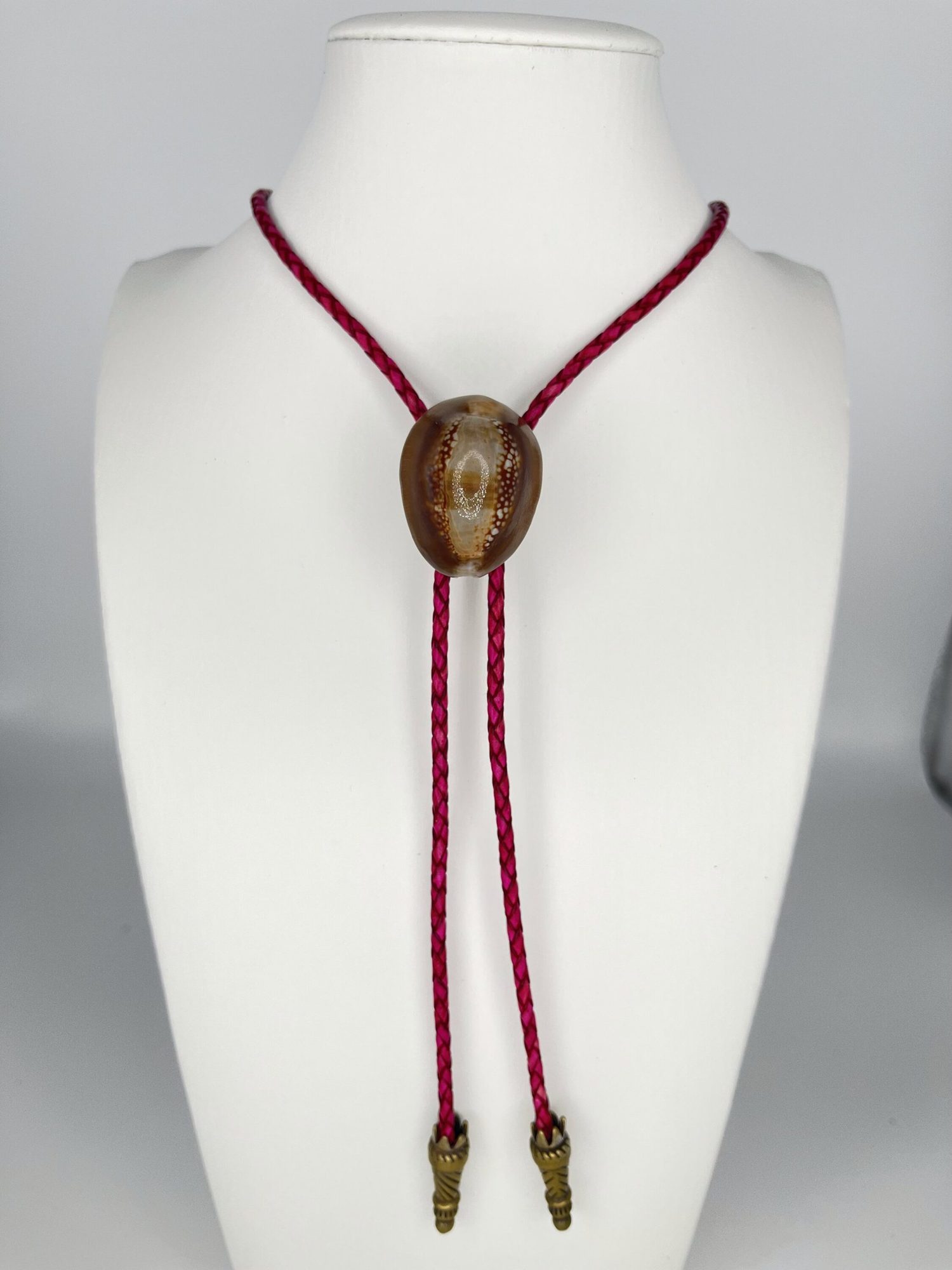
A cowrie is a glossy, egg-shaped sea snail shell with a toothed opening along its underside, and there is no single thing it means. In parts of Africa and Asia cowries were used as currency, which is why many people link the shell with wealth. In Hawaiʻi the cowrie is called leho, and cowrie shells were used in traditional octopus lures. To me it means a good morning on the shoreline, and it sits at the center of many of my bolo ties.
What a cowrie is, and why it shines
Some days the shoreline hands you a cowrie with its shine still on, and there’s a reason for that shine. While the animal is alive, it wraps soft folds of its body, called the mantle, up and over the outside of its own shell, and the mantle keeps laying down smooth, glossy shell.
Turn one over and you’ll see the long, narrow opening lined with fine teeth on both sides. I’ve always thought of it as a smile. From the top, a cowrie is a smooth dome. Kona Dusk, pictured above, is a smoky taupe cowrie on dark pink braided cord with brass-tone tips.
The cowrie in Hawaiʻi: leho
Leho is the Hawaiian word for cowrie. The shell had a working use here: cowrie shells were used in the traditional octopus lure, the lūheʻe.
I make jewelry. I’m not a historian or a cultural practitioner, so I’ll leave it at what is plainly documented, and I won’t speak for what the shell means in Hawaiian tradition.
Across the Pacific, the cowrie’s smooth shine has made it prized for adornment for centuries. If you want to set it beside the other shells I work with, my guide to Hawaiian shells covers the ʻopihi, cone, sunrise shell and puka too, and the ʻopihi has its own page.
What the cowrie means around the world
Ask ten people what a cowrie means and you may hear ten answers. The one piece I can state plainly is this: cowries were used as currency in parts of Africa and Asia, so it’s no surprise the shell is often linked with wealth. Beyond that, meanings differ from one culture to the next, and they aren’t mine to assign.
I don’t make any promises about what a shell will do for you. What I can tell you is what it is to me: finding an empty cowrie on the shoreline makes a good morning.
How I find them, and how they become bolo ties
Every cowrie at the center of the pieces in my shop today was gathered by hand in Kailua-Kona on the Big Island, taken empty from the shoreline. Nothing is collected live.
Back home, each cowrie is cleaned, tumbled and hand-polished. A few get more work. Secret Lavender is a cowrie sanded open to reveal a polished lavender window beneath its frosted shell. Leopard Violet is a large cowrie polished to a violet window and framed in dense leopard spots, with shell tips on dark pink cord. None of that color shows on the beach. How the work is done is in Lapidary 101.
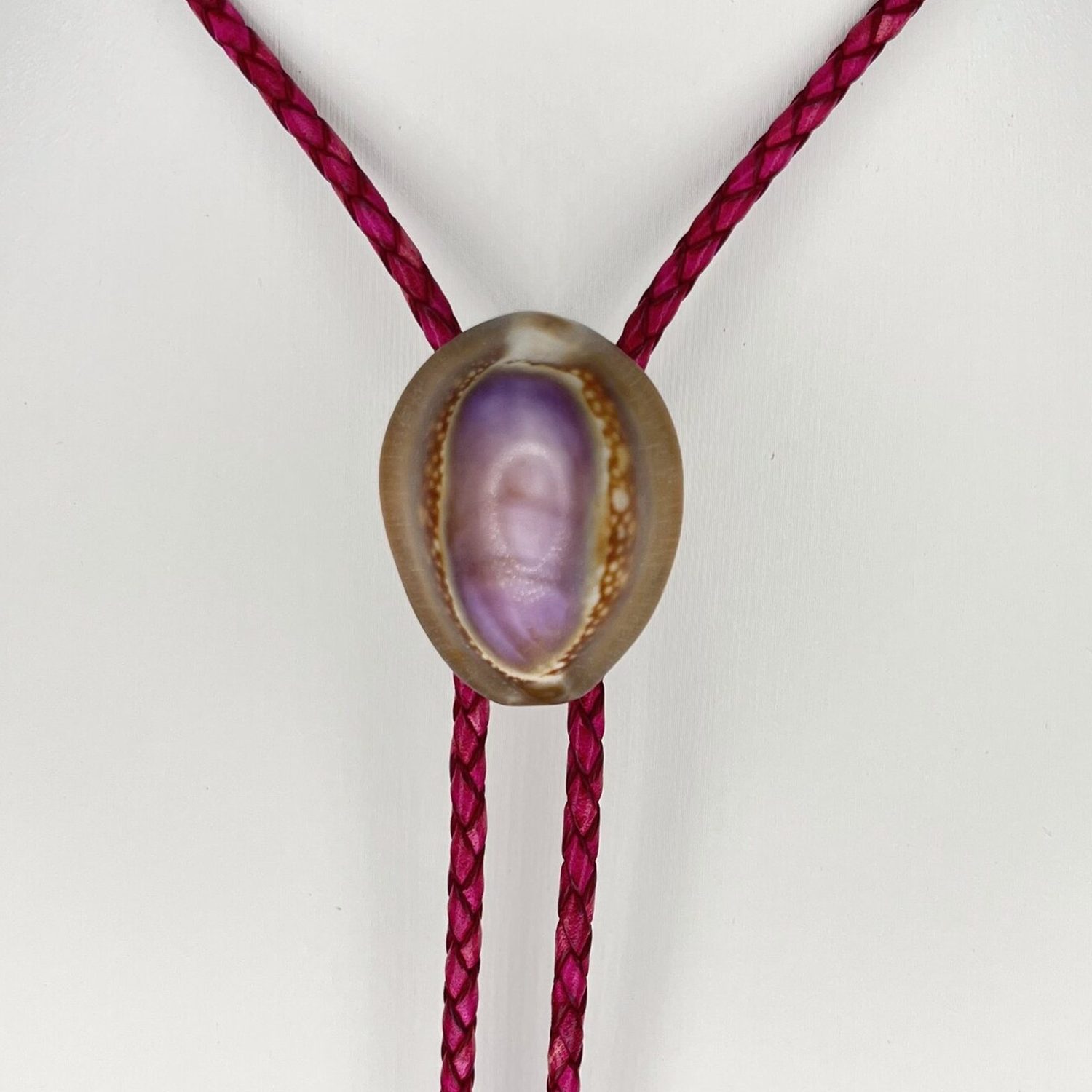
Then the shell is matched with a braided leather cord and tips. Starry Night, a cinnamon cowrie dome scattered with tiny white stars, is on dark pink cord with brass-tone tips.
As I write this on November 13, 2026, 15 of the 43 pieces in the shop are cowries, and no two look alike. The four named here are $145 each as of November 2026, and each has a metal slide clasp on the back. There is one of each, so any of them may be gone by the time you read this — each link shows whether it still is.
They’re made to be worn by anyone. A cowrie bolo works as well worn long as a necklace, the way I describe in bolo ties for women, as it does at a collar.
Finished pieces ship within 1–3 business days by USPS Ground Advantage, free within the US, and transit is typically 3–8 business days. Collection pieces can be returned within 14 days of delivery; you cover the return postage, and commissions are excluded.
Quick answers
What does a cowrie shell symbolize?
There is no single meaning. The best-documented one is wealth, because cowries were money: the small yellow money cowrie circulated as a medium of exchange in parts of Africa and Asia. The British Museum describes cowries as symbols of wealth and well-being across Africa, and Ghana’s currency, the cedi, takes its name from the Akan word for cowrie.
Beyond that, meanings differ from one culture to the next. In Hawaiʻi the use I can point to in museum collections is a practical one: the cowrie was the working part of the octopus lure. I don’t claim a meaning for the shells I work with.
What is the Hawaiian name for a cowrie shell?
Leho. The cowrie also had a working job in Hawaiʻi: it was the heart of the octopus lure, the lūheʻe (also recorded as leho heʻe). A cowrie was lashed to a stone sinker and a wooden shank with a hook, lowered from a canoe and jigged up and down; the octopus grabbed the shell and was hauled up. Bishop Museum describes the lure in its Hawaiian fishing displays, and the Smithsonian holds an example.
How do I care for a cowrie shell bolo tie?
Keep the leather cord dry, put the bolo on after lotion, sunscreen or perfume have dried, and buff the shell with a soft, dry cloth. Store it somewhere cool and dry where the shell won’t knock against harder jewelry. The full routine is in how to care for a shell bolo tie.
I’m Aaron, and I make Holo Holo Bolo in Kailua-Kona. If a cowrie in the collection speaks to you, there is only one of it.
— Aaron