Hawaiian jewelry for men comes down to a handful of things: puka shell necklaces, gold heirloom bracelets and rings, carved fishhook pendants, koa wood pieces, and shell bolo ties. The ones worth wearing share two qualities: the material has a real story behind it, and the piece was made by someone you could name. The rest of this guide is how to tell the difference, from someone who makes one of those five things in Kona.
The five kinds you’ll see in the islands
- Puka shell necklaces. The classic. Puka means “hole” in Hawaiian: a true puka is a piece of shell the surf has worn into a small dome with a natural hole in the middle. Many strands sold today are cut and drilled to look that way. Either can make a good necklace. Ask the seller which one you’re buying.
- Heirloom bracelets and rings. Gold, black enamel lettering, engraved scrollwork. The style is usually traced to the Hawaiian monarchy era of the 1800s. If you want gold, this is the classic choice. I don’t make these, so buy from a jeweler who does.
- Fishhook pendants. Makau is the Hawaiian word for fishhook, and you’ll see the shape carved in bone, wood, stone and metal.
- Koa wood. Rings, bracelets, inlays. Koa is a hardwood native to Hawaiʻi with a warm, shifting grain.
- Shell bolo ties. This is the one I make, so take my enthusiasm with a grain of salt. A polished shell on a braided leather cord, worn at the collar or long like a necklace. How to wear one is in bolo ties for men. The same piece worn long is a pendant, which is the subject of bolo ties for women.
How to tell island-made from souvenir
The word “Hawaiian” on a tag can describe the shelf a thing sat on rather than where it came from. Three questions sort most of it out:
- Where did the material come from? A good maker answers this plainly. If the answer is vague, that tells you something.
- Where was it made, and by whom? “Designed in Hawaiʻi” and “made in Hawaiʻi” are different sentences. Ask which one is true.
- Is there only one? Hand-gathered material doesn’t come in matching sets. If a rack holds rows of identical pieces, ask how they were made.
I’ll hold myself to the same questions. As I write this on November 13, 2026, 43 pieces are available. 37 are built around a shell, and all but one of those shells were gathered by hand in Kailua-Kona on the Big Island, taken empty from the shoreline. The exception is a clam gathered on an island in Vietnam and carried home, and its listing says so. The other 6 pieces are a different case: the stone is curated stone from Southeast Asia, and I hand-finish each tie here in Kona. Every piece ships with a hand-signed provenance card recording where its centerpiece was found and when the piece was finished. If you’re curious about the shells themselves, my guide to Hawaiian shells covers what’s what.
Four pieces on the bench right now
To make it concrete, here are four that are available as I write this. Prices are as of November 2026. There is one of each, so any of them may be gone by the time you read this — each link shows whether it still is.
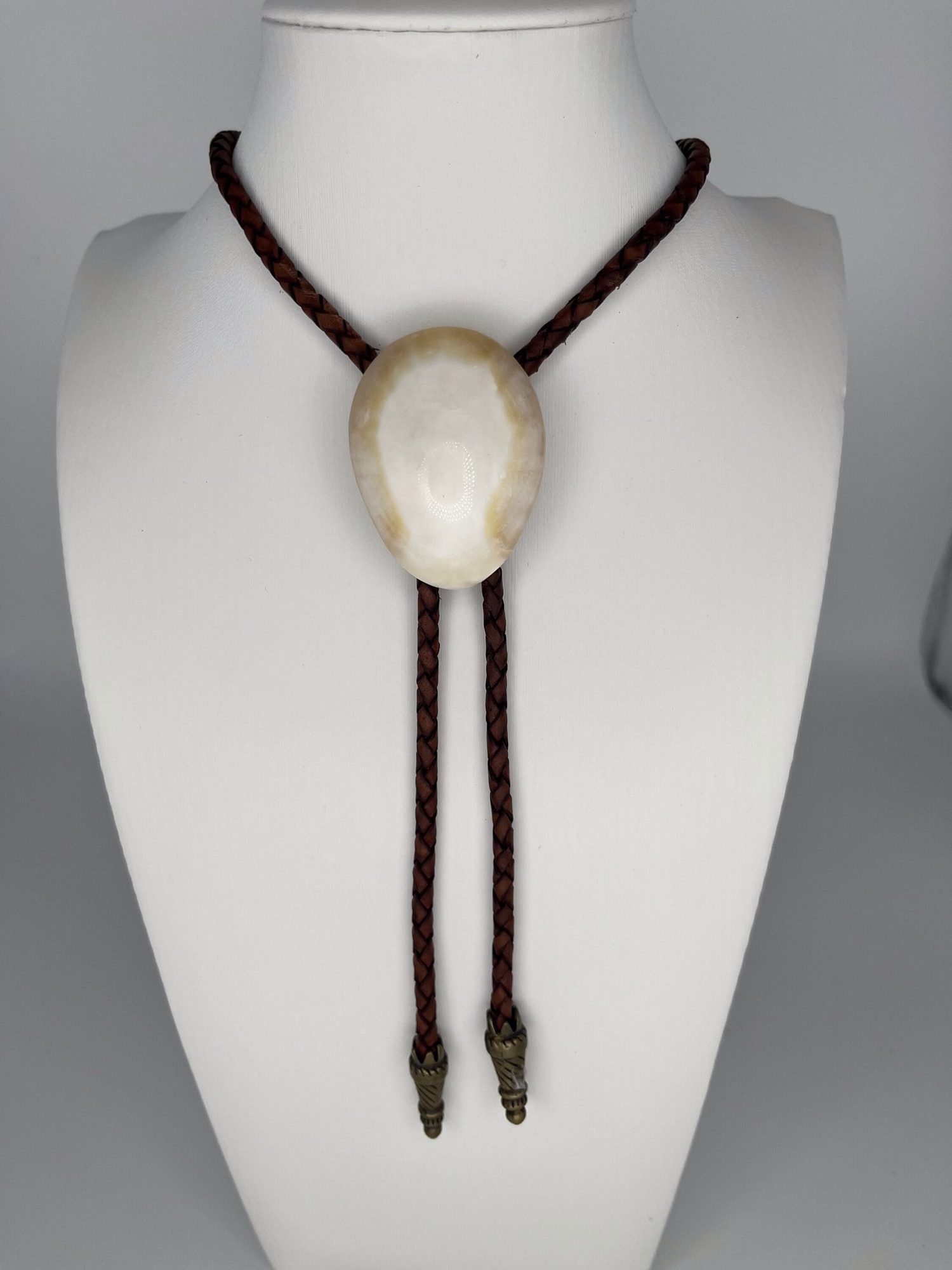
- Moon Egg — $145. A smooth, blushing white ʻopihi polished to a soft glow, on dark brown braided leather with brass-tone tips. Metal slide clasp.
- ‘Tiger Eye Look’ ʻOpihi — $145. An ʻopihi banded with warm tiger-eye tones, about 60 by 47 mm, laced clasp-less on a brown-grey leather cord with brass-tone tips.
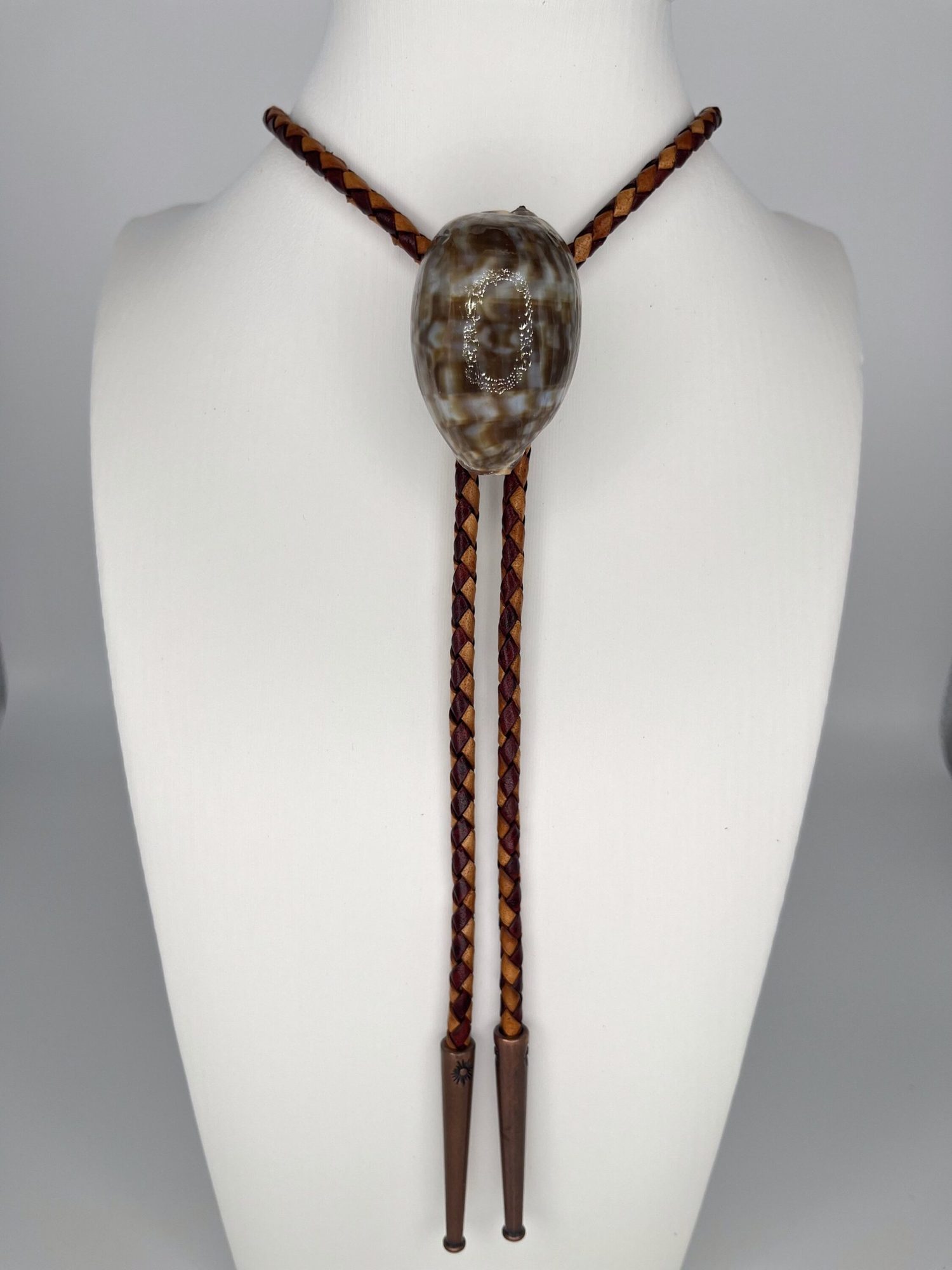
- Smoke Signal — $145. A smoke-and-cream mottled cowrie on a two-tone braided leather cord with copper-tone tips. Metal slide clasp.
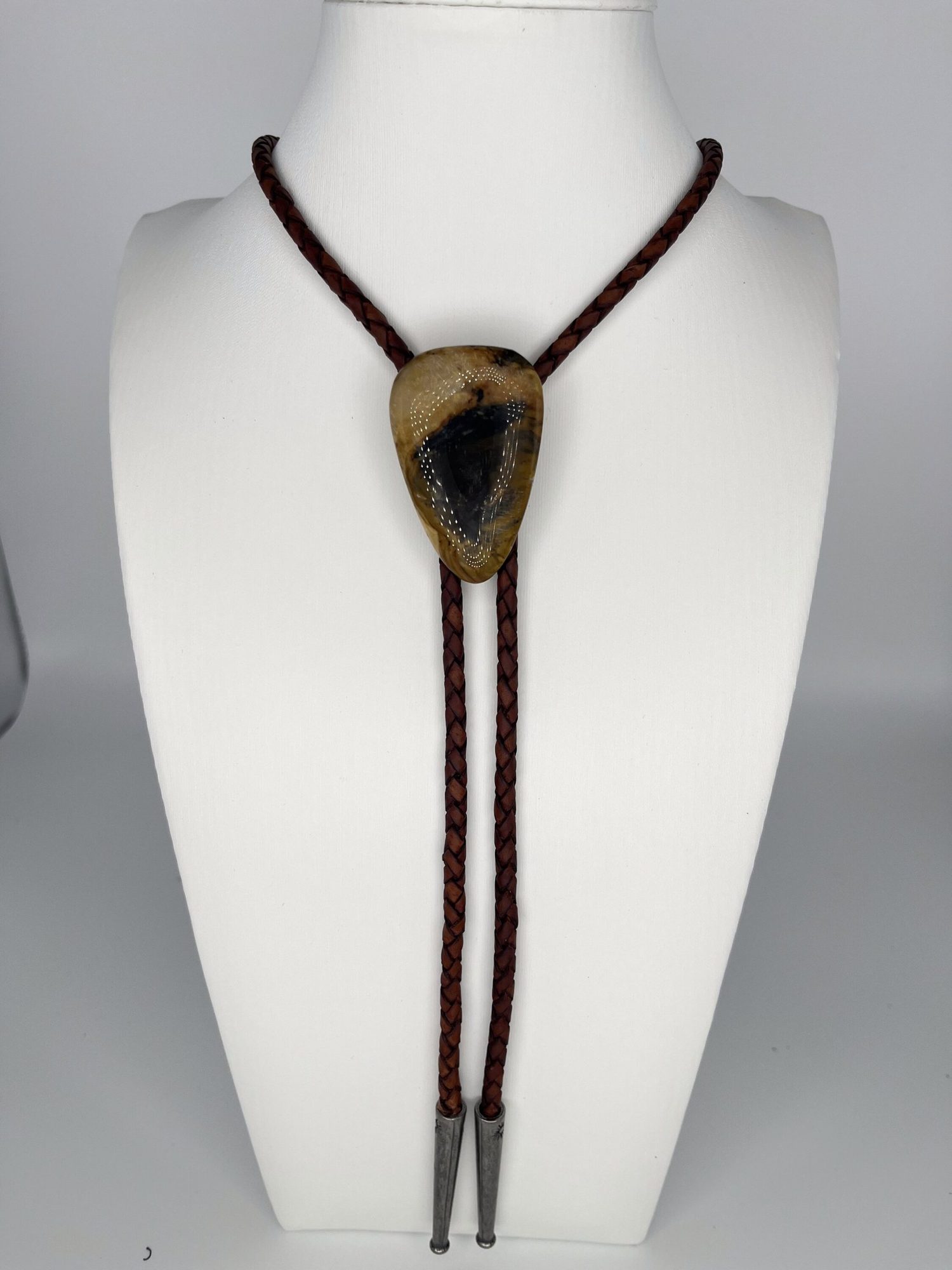
- Amber Night — $145. Not a shell: a curated stone from Southeast Asia marbled in olive, amber and black, on dark brown leather with silver-tone tips. Hand-finished in Kona.
Why a shell bolo works for men who don’t wear jewelry
If you’d say “I’m not really a jewelry guy,” I get it.
A bolo tie sidesteps that. It sits where a necktie sits, so it reads as clothing first and jewelry second. And it loosens in a moment when the evening relaxes.
The shell does the talking. An ʻopihi, the Hawaiian limpet, can polish up with bands and rays of color, and no two are alike. Cowries come up glossy, often spotted or mottled. If someone asks about it, you have an actual story to tell rather than a brand name.
Of those 43 pieces, 20 are what I call clasp-less: the cord laces through four holes I wet-drill by hand in the shell, with no metal clasp and no glue. They suit a man who wants something earthy rather than polished. The other 23 have a metal slide clasp on the back, the classic bolo mechanism.
Buying one as a gift
Jewelry from Hawaiʻi makes a good gift because it’s tied to a place. If he’s been here, it can bring the trip back.
- Sizing is forgiving. A bolo cord adjusts by moving the slide, so you don’t need a ring size or a neck measurement. Each listing gives the cord length.
- Pick by color, not species. Look at what he already wears and choose a shell that sits well with it.
- Expect a handmade price. As of November 2026, every available piece is $145 except one at $185, and shipping within the US is free. Where that goes is in how much a handmade bolo tie costs.
Finished pieces ship within 1–3 business days by USPS Ground Advantage, and transit within the US is typically 3–8 business days. For Christmas delivery in the US, order by December 7.
Caring for shell and leather
Natural materials want the same few things. Keep them dry when you can, wipe them with a soft, dry cloth, and store them flat, not tangled in a drawer with keys. Water can weaken leather, so take a bolo off before you swim. Treated that way, a shell piece can last long enough to hand on.
Quick answers
What Hawaiian jewelry is made for men?
The forms you’ll come across are gold heirloom bracelets and rings, carved fishhook (makau) pendants, puka shell necklaces, koa wood pieces and shell bolo ties. I make only the last of those, so for the others, look for a maker who specialises in them.
How do I know a shell piece is real?
Look for variation. Natural shell has small flaws, uneven color and its own shape. Then ask the maker where it was found. A real answer is specific.
How much does a Hawaiian shell bolo tie cost?
As of November 2026, every available Holo Holo Bolo piece is $145 except one at $185, and shipping within the US is free.
Can a gift be returned?
Collection pieces can be returned within 14 days of delivery. The buyer pays return postage, and commissions are excluded. Full details are on the Shipping & Policies page.
I make every piece myself in Kailua-Kona, and there is only one of each. The current collection is at holoholobolo.com.
— Aaron