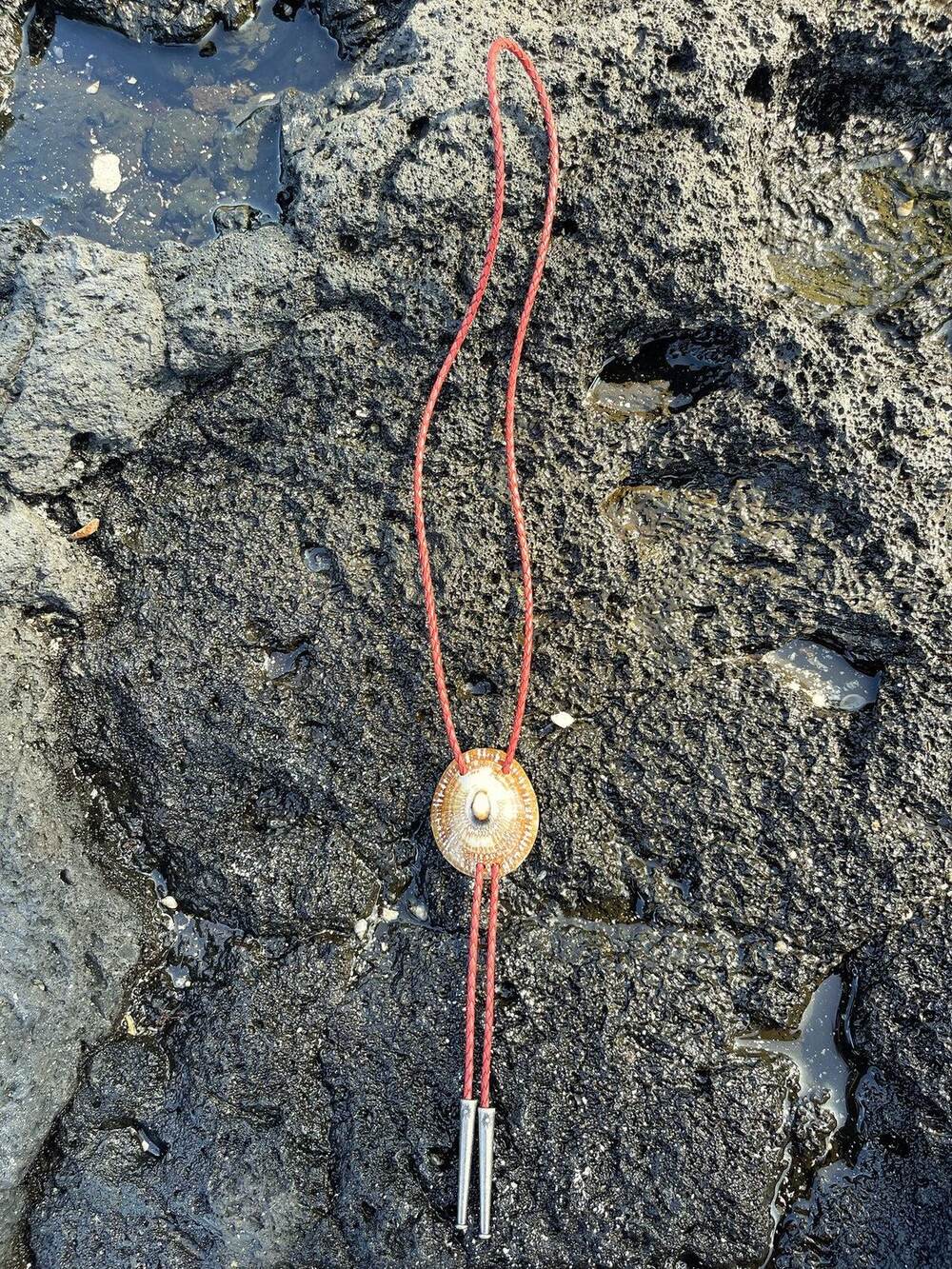
To wear a bolo tie, button a collared shirt to the top, drop the cord over your head and slide the clasp up to the collar — snug for a dressed-up look, an inch or two lower for casual. There is no knot to tie. With an open collar or a plain tee it becomes a statement necklace.
That is the whole method. The slide does the work a knot does on a necktie, which is why a bolo goes from the grandstand to a wedding without changing anything but its height. A few of mine — Morning Rays, an ʻopihi with rust-brown rays on metallic gold cord, and Snow Tide, a milky ʻopihi laced clasp-less on metallic gold — have no metal slide at all; the cord itself is laced, which I explain in the metal-free bolo tie.
I'll admit it: I've loved bolo ties my whole life. Whenever I spot someone wearing one, I can't help myself — I catch their eye and say, "Hey, nice bolo." And when I'm wearing one of mine, I get the same thing right back, all the time. There's something about a bolo — funny, funky, different, undeniably its own thing — that makes people light up and want to talk. A regular necktie has never once started a conversation for me. A bolo does it every time.
So if you've been bolo-curious but weren't sure how to pull one off, this is for you. First a little history — because it's a good one — and then exactly how to wear a bolo tie.
Where the bolo tie came from
The bolo is a true piece of the American West. Its modern form is usually traced to Victor Cedarstaff of Wickenburg, Arizona, who created and later patented a slide design in the late 1940s. As the story goes, his hatband slipped off while he was out riding, so he looped it around his neck and fastened it with a silver clasp — and the idea was born. He named it after the boleadora, the weighted cord that South American gauchos used.
A funny full-circle moment: back in my corporate days, I actually spent time in Wickenburg myself — I was the project manager for a dialysis center being built there. I had no idea I was wandering around the birthplace of the bolo, the very thing I'd one day build my life around. The universe has a sense of humor like that.
But the bolo's roots run deeper than one inventor. Native American silversmiths — Navajo, Zuni, and Hopi artisans especially — were already crafting cord-and-slide neckwear set with silver and turquoise, drawing on their own jewelry traditions. The bolo as we know it grew out of that craftsmanship, worn by Native artists and cowboys alike. It has always been, at its heart, a handmade object — a small canvas for an artisan's work. That's a big part of why it speaks to me.
Where the bolo tie is worn
The bolo is the unofficial — and in some places, very official — neckwear of the American Southwest. Arizona named it the state's official neckwear back in 1971. New Mexico made it the official state tie in 2007, and Texas did the same that year. Across Arizona, New Mexico, and Texas you'll see bolos everywhere, from rodeos to weddings to the statehouse.
It carries that western, cowboy spirit — denim, boots, wide-open skies — which is exactly the vibe I've always felt from it, too. But these days the bolo has wandered far beyond the Southwest. You'll find it on musicians, artists, designers, and anyone who likes a little individuality at their throat.
How to wear a bolo tie
The best news: there's no single right way, and that's the whole charm. But here are the moves that always work.
- Start with a collared shirt. The classic and easiest look. Button the shirt to the top and let the bolo sit at the collar, just like a tie. A crisp button-down or a western snap shirt are the bolo's natural homes.
- Let the slide set the tone. Slide it up high and snug for a polished, dressed-up look; leave it an inch or two lower and looser for relaxed and easygoing. The same bolo can read formal or casual depending on where you park the slide.
- Dress it up. A bolo under a blazer or suit jacket is quietly striking — perfect for weddings, events, or any time you want western elegance instead of a standard tie. It's become a favorite for grooms and groomsmen for exactly that reason.
- Dress it down. With an open collar, a linen shirt, or even a plain tee, a bolo becomes more like a statement necklace — ornamental, easy, and modern.
- It's for everyone. Men and women both wear bolos beautifully. Layer it, wear it long, wear it short — there's no gender to it, only style. (More in bolo ties for women and bolo ties for men.)
- The real rule is confidence. A bolo rewards the person who wears it like they mean it. Put it on, stand a little taller, and own it. People will notice — and some of them will say, "Hey, nice bolo."
"There's no wrong way to wear what is truly yours."
A Hawaiian take on a western classic
My bolos carry that same independent spirit, but with a piece of the Pacific at the center instead of silver and turquoise. Each one is built around a single hand-gathered, hand-polished shell — often an ʻopihi from a Hawaiian shore — so no two are ever alike. It's the western classic I've always loved, wandered all the way out to the islands and made one of a kind.
So find one that feels like you, set the slide where it suits your mood, and wear it your way.
Quick answers
How do you put on a bolo tie?
Loosen the slide, drop the cord loop over your head, then push the slide up toward the collar until it sits where you want it. There is nothing to tie or knot — the slide holds the position by friction.
How high should a bolo tie sit?
For a dressed-up look, snug at the top button of a collared shirt, exactly where a tie knot would be. For a relaxed look, an inch or two lower. Worn as a necklace over an open collar, let it hang wherever the shell looks best.
Is a bolo tie formal?
It can be. A bolo under a blazer or suit jacket is accepted formal neckwear across the American Southwest — Arizona, New Mexico and Texas all name it official state neckwear — and it has become a favourite for grooms and groomsmen. Slide it high and keep the shirt buttoned for formal settings.
Can you wear a bolo tie without a collar, or with a short-sleeve shirt?
Yes. With a tee, a linen shirt or a short-sleeve button-up, a bolo reads as a pendant on a cord. It is the easiest, most modern way to wear one; a collar simply gives it a more traditional frame.
What is a bolo tie?
A cord — usually braided leather — held at the neck by a decorative slide and finished with metal or shell tips. Its modern form is traced to Victor Cedarstaff of Wickenburg, Arizona, in the late 1940s, building on Navajo, Zuni and Hopi cord-and-slide neckwear; the full story is in The History of the Bolo Tie.
— Aaron